Tuesday, December 3, 2013

La tradición de la quinceañera - Terri Schneider

 The 15th birthday celebration of a young, Mexican woman or la quinceañera is one still of utmost importance for today’s Mexican adolescents. 
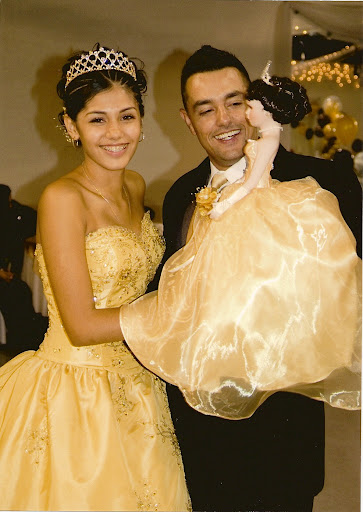
"La ultima muñeca"


Having its history in ancient Aztec culture, this tradition still pertains to the young generation of today even within the United States. After interviewing a young woman from the North Augusta area about her experience of her quinceañera , it was made clear that there are many traditions saturated with symbolism that give this celebration a more significant purpose. This includes the giving of "la ultima muñeca" (the last doll) from her father, the  choreographed surprise dance with her "chambelanes" (chamberlains) and/or "damas" (dames), and the exchanging of her tiara for a crown as well as her flat shoes for high heels. Despite the fact that a majority of the non-Hispanic population of the United States hasn’t ever heard of this rite of passage, the Mexican-American communities all across the nation are aware and care. The cost of this celebration does cost a pretty penny/peso, so $10,000 is not an uncommon site for the family of la quinceañera . While this amount is shocking to the average American who isn’t spending that sort of money on a fifteen-year-old girl in one place, for the average Mexican/Mexican-American the burden of cost will generally be made lighter with well advanced planning and help from extended family and friends as the Hispanic population is accustomed to the idea of community contribution.


La quinceañera and her "chambelanes"


I intend to uncover the symbolism behind the various things and actions that are seen throughout the birthday celebration. I will approach this subject using the functionalist theory and reflect upon the obvious collective effervescence that insures a purpose for these coming-of-age events.  

Brooke Hunter

Today, people find so many different ways to entertain themselves. Recently, millions of people have taken to making short videos of themselves or others and posting them online for the world to see. Besides the ever-popular "YouTube," there is a semi-new app. called "Vine" that allows anyone to film a short video on their smart phone and post it for everyone to see in just seconds.

Vine's history is a rather short one. It was introduced earlier this year, but it did not take long for it to become one of the largest app. market growth stories. With most of its success in Norway, Vine is a top ten iPhone app. in seven different countries.

Vine videos are easily recognized by society. For those who have not downloaded the app. to their phone, Vine has its very own Facebook and shares users' posts quite frequently. These videos are typically humorous which makes them well-liked by many. The Vine phenomenon is a great illustration of the functionalist theory. Vines often consist of re-enactments of things that certain groups of people do, or daily struggles and annoyances that most people can relate to. That relatability helps create a unity amongst people.

In my paper, I will analyze the Vine phenomenon as well as other apps. that are similar to it. I will expand on the history of Vine, and elaborate on its connection to the functionalist theory.


Monday, December 2, 2013

Brooke Stahler

The Harry Potter series has become a phenomenon that has captured the imagination of children and adults all around the world. The author of the series, J.K. Rowling, was inspired to begin writing Harry Potter in 1990. Today, the series consists of seven different books and eight different movies. Harry Potter is now one of the highest grossing film franchises in history. Over the course of ten years, the films have grossed in nearly 8 billion dollars worldwide.


For my cultural analysis term paper, I plan on using both the functional and critical perspective to discuss Harry Potter. The series reflects and reinforces values and creates collective effervesence among fans. The critical perspective can be applied to the merchandise and mass production of all things Harry Potter. The merchandise ranges from food and candy, toys and games, clothing and accessories, and collectibles. In 2010, The Wizarding World of Harry Potter opened as a portion of Univeral's Islands of Adventure in Orlando, Florida. Many believe that Harry Potter will continue to flourish and fascinate future generations.


Kayla Lunsford- Catching Fire


The movie Catching Fire is an interesting Social Event not only on premier night but also looking into movie and book content it becomes a cool picture of history that most people don't even catch.  In the movie, Cinna, the guy that designed Katniss Everdeen's dresses and more specifically her wedding dress is actually historically relevant to Roman times.  There was a man named Lucius Cornelius Cinna who served as Roman consul, he was driven out of Rome after inciting a rebellion among the freed men of the city.  Cinna in the movie designed Katniss' wedding dress to morph into a mockingjay with wings and everything as an act in support of the growing rebellion against the Capitol.  I think this was one of the biggest rebellious moves in this movie, albeit symbolic it was still rebellious and brave.

 Cinna the rebellious fashion designer

On the pop culture end of things The Hunger Games: Catching Fire brought in $161.1 Million in its opening weekend.  This makes it the biggest November debut ever and the most lucrative Lionsgate opening.  Catching Fire was highly anticipated and well received; even those that have read the books feel that it was very true to the book more so than they would have expected.

I feel like the Hunger Games movies, especially Catching Fire has kind of made people think about the state of our own country and how things are going.  I have seen and heard quite a few almost nervous sounding people talking about what kind of things could happen in the future and whether they think the stuff of these movies is actually plausible.
I would also say that it is pretty safe to say that the recent trend in movies like White House Down, Olympus Has Fallen, and the Hunger Games has definitely made a large number of people nervous of government control.  Not that some of these people weren't already nervous but more so that this type of media makes them even more nervous than they already were.
This trend could be good and bad, good because it actually makes people think about what is going on with the government and how it actually relates to them rather than walking along blindly.  It could also be a bad scenario causing people to be too distrustful of the government overall.
So, are the odds EVER in our favor? :)


Daniel Bussey


Kanye Omari West was born in Atlanta, Ga then moved to Chicago with his mother at the age of 3. It is said that he began his creative side while writing poetry and drawing at a young age. Growing up on the city streets of Chicago taught him many lessons and this is where he found his passion for music. After dropping out of college he began to further dive deeper into his musical aspirations.
He connected with his "mentor", a man by the name of No I.D. and began to make tracks for local artists to use.

It is that time he found his way to Jay-Z who was a major artist and started to work closely with him. After making most of Jay's tracks on the album The Blueprint, which was a classic on the hip hop scene, Jay signed him to his label. After a getting into a horrible car accident where he had to have his mouth wired shut, he made a track entitled Through The Wire which came off of his debut album The College Dropout and that helped him gain the #2 spot on the Billboard top 100. 

From then on he went on to make multiple albums and songs that hit the #1 spot on the charts and garnered him a lot of attention. The thing with him though is he's always in the media's eye for something negative that he has said or done. 
He has gone on to embarrass himself and others along the way. BUT there is one thing that we can always say is. That we want to know what he will do next. He has us on our toes, either creatively or negatively to see where he will "strike". 

Even with these multiple moments of negativity however you can't deny that musically and visually he has a very creative mind. He himself is a phenomenon in a sense. Now let's all wait to see what he does next because of course, we will want to know. 

TO BETTER SUM UP OUR "KANYE INFATUATION":
"I will go down as the voice of this generation, of this decade, I will be the loudest voice."
- Kanye West 


Kirsten Fitzgerald - "Racebending" in Film

While blackface and yellowface are now acknowledged to be racist and distasteful, the practice of casting white actors to either replace or represent characters of color often endures in the United States. Actors of color are already limited in the roles offered; in 2005, 81.9% of lead actors in movies were white non-Hispanic. When people of color are cast, those roles are often supporting roles and/or laden with stereotypes. Opponents of the practice argue that the casting of white actors for characters of color, or "racebending" limits both the options for people of color working in Hollywood and the way that pop culture consumers view people of color.

Recent controversies surrounding these casting choices include the casting of predominantly white actors to play Asian and Inuit characters in the live-action movie adaptation of Avatar: The Last Airbender, from which the term "racebending" was coined. Notably, the exception to this casting is the "bad guy".


In the original Star Trek series, the famous villain Khan was explicitly described as Sikh, though this was complicated by the casting of Ricardo Montalbán, who, while a man of color, was not actually Sikh or even Asian. However, it was 1967, and it was, like many things in the original Star Trek, still considered revolutionary that a man of color was selected to portray a genetically superior super-human. This year (almost fifty years later), Benedict Cumberbatch, a white British man, played the role of Khan in the Star Trek: Into Darkness, which many critics argue not only contributes to the trend of whitewashing, but sends a much uglier message once one considers the "genetic superiority" of Khan.

On the left, Benedict Cumberbatch. On the right, Ricardo Montalbán.
Original series Khan looks at a portrait of himself, in which he is wearing a traditional Sikh turban.
The critical perspective offers valuable insight into the reasoning behind and the impacts of the practice of racebending. The erasure of people of color from lead roles may serve to reinforce stereotypes when they are cast, as well as contribute to the dominant ideology that white people are somehow more palatable to the overall population, or that white actors are more capable than people of color to portray not only the "default" universal narratives, but also the narratives of people of color themselves.

The following video satirizes and provides further examples of racebending:


Kenya Murphy

Whether its a who got divorced, who got arrested or who is owes the IRS back taxes; we all love a good celebrity scandal! Reading about what celebrity couple sold their mansion, what former Disney child star recently was hospitalized, or what how much a NFL player spent on his fiancee's engagement ring has become as routine as drinking coffee and watching the news! We no longer watch the news just to find out the weather or about politics. We watch the news to find out if Beyoncé is indeed expecting again, how Paul Walker died and if Khloe Kardashian will divorce her NBA husband. Celebrity gossip has quickly become a new aspect of popular culture.